

Happy Healthy with Hadlee: Connecting with Nature

Earlier this month, we hosted a Zoom Class focused on health and wellness during the COVID-19 pandemic. We were joined by Health and Lifestyle Change Coach Hadlee Garrison – she had a ton of helpful information to share.

Here are some of Hadlee’s suggestions that we found to be most helpful during this difficult time.

Michigan Mortgage: Welcome back! We appreciate you sharing your knowledge with us!

Can you explain why our mental and physical health are so connected? Why are they so intertwined?

Hadlee: Often we think of a distinction between our physical health and our emotions, mental clarity, moods, and thoughts. But in actuality, our physical and mental health are inextricably connected.

The way we feel physically impacts our moods and emotions in both tangible and subtle ways. Physical injuries and disease can result in mental health issues. A less obvious but common example of this is overeating and experiencing lethargy, grumpiness, and/or mental fog.

And the way we think and feel mentally and emotionally can also manifest physically. This can be seen when a person experiences the placebo effect and is healed of a physical malady without actually getting the treatment they think they’re getting. It can also show up as physical disease down the road after years of repressed emotion or trauma.

While modern health sciences have historically focused only on physical health, we are finally seeing more attention given to the significant effects mental health plays not only in day-to-day quality of life but also in the physical health of all individuals.

It only makes sense that whatever is happening in one part of the body could create a cascade of effects to another part of the body. The brain is part of the body, so it can affect the rest of the body in both negative and positive ways, and vice versa. For a long time, we believed that the mind and the body didn’t really affect each other, but now modern research shows just how much we’ve overlooked the mind-body connection and how much each affects the other.

MM: This is so fascinating! One thing we talked about a lot on our call is the importance of getting out and enjoying nature. Can you explain that a little bit?

H: Time spent in nature is linked to a whole host of physical and mental benefits. It can:

  • Lower stress
  • Increase mental acuity and attention
  • Calm the nervous system
  • Increase levels of cancer-fighting “natural killer cells” in the body
  • Activate neural pathways associated with calm
  • Decrease levels of depression and anxiety
  • Enhance immune function

It really is so important to be intentional about getting outside right now, especially since we might be less likely to get outside during Shelter in Place because we aren’t going as many places.

Bonus: Pair your time in nature with movement for added health benefits!

MM: Tell us more about movement! Why is it so important for mental and physical health?

H: Movement is so important for both our physical and mental health. It’s not just about creating a physically fit body. Moving your body is incredibly important for:

  • Decreasing risk for chronic diseases like heart disease, obesity, type 2 diabetes, and some cancers
  • Strengthening bones and muscles and decreasing injury as you age
  • Improving sleep
  • Increasing resilience to stress
  • Improving moods throughout the day
  • Reducing risk for depression and anxiety.
  • Improving the structure and function of the brain, making you more mentally clear and focused and allowing you to learn information and make decisions with more clarity and ease.

MM: Thank you for your guidance! If people would like more information, or to connect with your directly, how can they do that?

H: Sign up for a 30-minute Health Goals Session, where we’ll talk about your health and life goals, challenges, and priorities, as well as next steps for achieving your wellness goals.

If you want to work with me further, you can indicate that on your Health Goals Session application. Here is the description for my Happy Healthy Habits program, where they can take a look at what I do with my clients and what I might be able to do for them if we find we’re a good fit for each other.

And if you want more tips, inspiration, advice, and other fun stuff, you can follow and/or direct message me on Instagram or Facebook @happyhealthyhadlee, or sign up for my newsletter. I respond to all questions and inquiries with as much support as I can, and welcome communication, especially during these challenging times. My passion is helping and empowering people to take control of their own wellbeing and life, so reach out and I’ll do whatever I can to help!


Happy Healthy with Hadlee: Coping During Coronavirus

Earlier this month, we hosted a Zoom Class focused on health and wellness during the COVID-19 pandemic. We were joined by Health and Lifestyle Change Coach Hadlee Garrison – she had a ton of helpful information to share.

Here are some of Hadlee’s suggestions that we found to be most helpful during this difficult time.

Michigan Mortgage: Thanks for joining us (again)! For those that missed our Zoom Class, can you tell us about the importance of health and wellness during this difficult time?

H: It’s so important right now to implement healthy routines each day in order to feel purposeful and have the structure to feel less stressed and more grounded. Otherwise our days seem to blur together and it can feel like we’re just trying to keep our heads above water. And that doesn’t even include all the other ways healthy routines can positively impact our physical and mental health during this time!



So many emotions are likely to arise right now. There are things we can do in the moment to cope with difficult emotions, and there are things we can do preemptively to build resilience so we can cope with future emotions in a healthy and fulfilling way.

MM: During our class, you mentioned the “RAIN” technique. Can you explain that a little bit?

H: In the moment, we can practice acknowledging and working through our emotions through a concept called RAIN, which stands for Recognize, Allow, Investigate, and Non-Identification.

  • Recognize: Turn toward your emotions with acceptance. Identify the emotion arising and acknowledge the physical sensation that accompanies it.
  • Allow: Allow the experience to be there just as it is. Accept that the emotion is there without denying it. Recognize that emotions are impermanent, and that even if it feels overwhelming in the moment, it will soon pass.
  • Investigate: Get compassionately curious with your emotions. You can ask yourself: ‘What triggered this emotion? Why do I feel this way right now?’
  • Non-identification: Practice non-identification, remembering that you’re not your thoughts, feelings, or emotions. You might be having a thought, feeling, or emotion, but you are not it. You are the observer of whatever is going on in your brain. Allow that to provide some relief.

MM: Thank you! I really think people can benefit from using that technique.

You are a wealth of knowledge, and I know we could go on for hours about this, but before we go, can you share a few health habits people can establish right now?

H: For being more mentally and physically resilient to stressors and viruses right now, we can practice tangible health habits. I suggest only choosing a few so as to not overwhelm yourself during this potentially stressful time, and sticking to those things consistently.

  • Pay attention to how your body feels: If you’re not aware of how your body feels, it’s hard to give it what it needs. Take time to feel your physical sensations: hunger, satiation, thirst, temperature, emotions, etc.
  • Sleep: Get enough high-quality sleep. You can’t make optimal decisions when you’re sleep deprived, and your brain will always work better when you’re well-rested. This is the most beneficial thing you can do for anxiety AND immunity!
  • Move: Being intentional about moving your body is now more important than ever, as we might be doing a lot less of it by default. Intermittent movement throughout your day helps improve both physical and mental health, as addressed below.
  • Nourish your body: Stick to foods that nourish your physical and mental health: namely vegetables, fruit, and other whole, unprocessed foods. Decrease consumption of processed and refined foods, alcohol, caffeine, etc., and drink enough water! Food can be a challenge during Shelter in Place. While it’s helpful to have nutrition knowledge and guidelines around how our bodies use food optimally, listen to your own body. Tap into hunger/ satiation cues to feed yourself well, and notice how different foods make you feel to empower future decision-making.
  • Breathe: Breathing seems like a given, but did you know that you can use your breath to actually alleviate anxiety? Try extending your exhale longer than your inhale for an immediate decrease in cortisol, the stress hormone.
  • Ground down with nature: Connecting with nature is medicine against anxiety and fear. Try walking in the woods or exploring your backyard. If you can’t leave your house, look outside your window or grow a potted plant.
  • Schedule screen time: Put away the devices for designated periods of time each day, including consuming the news. You can still set aside time to get informed each day, but being constantly inundated with information about coronavirus isn’t helpful for your mental, physical, or emotional health.
  • Connect: Just because we’re physically distant doesn’t mean we have to be socially distant too! It’s important to be intentional about our social interactions right now. Video chatting, phone calls, and good old-fashioned letter writing can be incredibly refreshing and invigorating.
  • Help: The fastest path to feeling a sense of purpose? Helping another person!
  • Leave some space: Give yourself enough space in your day/schedule. Even in quarantine, we need down time to do something simply for the sake of enjoyment.
  • Be kind to yourself: Cut yourself a little bit of slack: this is collectively a stressful and uncertain time, so allow yourself to not get everything done, to fall apart, to use kind words when talking to yourself.

MM: We can’t thank you enough! Stay well, Hadlee!

Stay tuned – we will share more from Hadlee in the coming weeks.

Story Time with Grand Haven Area Public Schools


Our friends at 92.1 WGHN are hosting Story Time and we are so excited to be involved!

We teamed up with the West Michigan Lakeshore Association of Realtors to sponsor the daily segment with Grand Haven Area Public Schools. Tune in at 8:40 a.m. Monday – Friday to hear some of our favorite stories.

Story Time’s first episode aired this morning. Press play below and enjoy a sweet story with your family.

Life Outside of Loans: It’s All About Escapism

My kids and I are obsessed with the new Animal Crossing game.

All my waking hours outside of work have been dedicated to fishing, selling turnips and hunting tarantula. I’m not proud to admit the amount of time we’ve collectively spent building up our new island home.

It has struck me how quickly I became reliant on the game for entertainment, a sense of accomplishment, and even something to bond with my kids over. I’ve wondered why it’s felt so important in my life, and clearly, it’s all about escapism.

Health and WellnessWe look for answers outside of ourselves and our homes, external ways to feel better. Some are healthy outlets (gym memberships, meditation classes), and others aren’t always healthy (Animal Crossing, retail therapy, going to the bar).


Now we’re suddenly stuck at home for weeks on end with restrictions and pressures that most adults have never had to face. We’re adapting to working outside of the office, or not working at all. Many of us have school-aged children that suddenly require us to oversee school work, or maybe elderly family members that are now isolated and without our help.

So, what happens when we combine the added stress while our sources of outside relief disappear?

Where do we find peace in the face of uncertainty?

For a culture that is so ingrained in believing our emotions are controlled by the situations and circumstances around us, this pandemic is perhaps the reset button we need.

Because peace and relief don’t come from the places we go, the things we buy, or what’s being reported on the evening news.

It comes from within.

But it’s so often drowned out with the external sources that many of us are now left in silence, struggling to reconnect with that inner voice, the source of emotional power within each of us that is out of shape and needs to be exercised.

While it’s tempting to just say that these are unprecedented times, and that a little escapism is ok, think about how you want your life to look at the end of this pandemic.

Do you want to have a beautiful home built in an imaginary video game world, or do you want to declutter your actual home?

Do you want to literally stay huddled in your home for weeks, or instead maybe get outside and walk, ride bikes, and try your hand at gardening?

Do you want to come out of the other side of this as the same person and society that went into it, or do you want to double down and come out more resilient and stronger?

Neither answer is right. I’m definitely not saying that I’m giving up Animal Crossing. But there is a choice to be made, and I encourage you to make that choice consciously.

Tips for Building Immunity During the COVID-19 Pandemic

We’re living in uncertain times.

As the COVID-19 pandemic spreads, people are asking what they can do to stay healthy and keep their loved ones safe.

The most impactful things you can do to prevent the spread and avoid exposure are still to:

  1. Wash your hands often with warm water and soap for at least 20 seconds. Use hand sanitizer when you don’t have access to a sink.
  2. Keep your hands away from your face to avoid transferring germs either from others to yourself or from yourself to others.
  3. Clean and disinfect frequently used surfaces like doorknobs, light switches, phones, counter tops, keys, wallets.

It’s also important that we keep our immune systems strong during this time in order to prevent it.

I’m not going to sell you on any products to boost your immune system, as there have not been any supplements shown to prevent COVID-19. I am going to promote lifestyle changes that universally enhance our immune systems and act as an important line of defense if and when we are exposed.

8 TIPS FOR BOOSTING IMMUNITY

Sleep! The most beneficial thing you can do for your immune system at any time is to get enough sleep!! Right now, getting somewhere between 8 and 10 hours is best, getting to bed as early as possible and letting your body sleep as long as it needs.

Stay hydrated. Drink enough water to wash out toxins and bacteria from your body. Avoid drinks that are dehydrating, like coffee and alcohol, as much as possible.

Aim for a consistent routine. Having a regular routine calms the nervous system and reduces stress and anxiety, both of which negatively impact the immune response. So getting to bed and waking at the same time, eating around the same times, and staying consistent with other health practices as much as possible positively impacts immunity. Don’t know where to start in automating your habits? Sign up for a Health Goals Call if you want to figure out next steps.

Avoid sugar and vegetable oils. Both sugar and highly processed vegetable oils (canola, corn, sunflower, safflower, soy, cottonseed, grapeseed, etc.) are toxic in the body and dampen the immune system. Cutting out sugar and vegetable oils as much as possible can be extremely beneficial for health in myriad ways. Cook with coconut oil, ghee, grass-fed butter, avocado oil, almond oil, etc. instead. Opt for foods that don’t have added sugar or vegetable oils in the ingredients list.

Eat immune-boosting foods. Immune-boosting foods are the ones we hear about for staying healthy in everyday life: lots of vegetables, antioxidant– and vitamin C–rich fruits, bone broth, probiotic foods, herbs and spices (i.e., turmeric w/ black pepper, ginger, garlic, oregano, etc.), nuts and seeds, high-quality animal proteins (stay away from low-quality meats from animals that ingest hormones and/or antibiotics in their lifetime).

Set up boundaries for how much information you take in. While it’s important to stay informed, it’s also important that we don’t stress ourselves out too much and thus tax our immune systems. It might be helpful to set a time in your schedule dedicated to looking at COVID-19 updates, and spend the rest of your time doing something else.

Get outside. Being outside in fresh air is great for our bodies, and also does wonders for our mental health, both of which impact our immune systems. Vitamin D from the sun is important for building immunity, and there is evidence that organic compounds emitted by plants called phytoncides also boost immune function.

Practice mindfulness. Meditation and other mindfulness practices both calm the nervous system and boost immunity. For most of us, this is a stressful and scary time, and that stress can tax our immunity. Setting aside a consistent time each day to practice some sort of mindfulness helps mitigate some of that stress and thus buffer the immune system.

Unsure of how to start doing these things consistently? Schedule a Health Goals Call with me to talk about your current lifestyle and next steps for building up the habits to stay healthy. I look forward to speaking with you and helping you take control of your health!

In the meantime, stay safe and healthy everyone!

Guest Blogger Hadlee Garrison, Happy Healthy with Hadlee

#MMGivesBack: Realtors Who Care

Realtors Who Care is the charitable arm of the West Michigan Lakeshore Association of Realtors. Their goal is to make our local community a better place to work and live.

Mission Statement: Realtors Who Care shall strive to support Realtors first, people focused local charities, individuals in need and the National Association of Realtors recommended disaster relief.

They often give $300 to support individuals and charities in need and $600 to Realtors in need and disaster relief efforts designated by the National Association of Realtors.


Loan Officer Hayley Woodworth is Co-Chair of the Realtors Who Care Committee and selected the non-profit organization as this month’s #MMGivesBack charity.

Why?

“Realtors give back so much to their clients and communities,” she said. “I think it is important that we support them when they are in need. We meet so many people through this industry, and when you meet someone going through a hardship, it’s such a great feeling to be able to help them.”

The group experienced a very successful 2018 full of giving but has even bigger dreams for the year ahead.

“The goal for 2019 is to raise as much money as possible so we can give more than we ever have back to the local community,” Woodworth said. “We are also striving to gain as much exposure as possible so Realtors, affiliates and the community become aware of our organization.”

“We want to get more people involved and encourage more requests and submissions for donations for people and places in need,” she said.

How can you get involved?

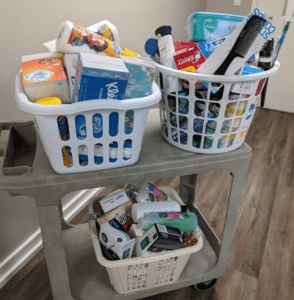
“In May, Realtors Who Care collects toiletries and personal items for local shelters and food baskets,” Woodworth said. The group takes the donated items and assembles baskets for those in need.

Items include: shampoo and conditioner, toothpaste, paper towel, feminine products, deodorant, tissues, and other household items used on a daily basis.

More information about Realtors Who Care, their mission and the May Basket charity initiative is available on their Facebook page.

#MMGivesBack: Kids’ Food Basket Muskegon

“Kids’ Food Basket is a grassroots, community solution to childhood hunger. We engage all who care about children reaching their full potential – in school and in life. We began over a decade ago by serving 125 kids each school day through our Sack Supper program and now serve nearly 8,000 kids each weekday in West Michigan.”

Our January Employee of the Month, Danielle Woodring, recognized the work Kid’s Food Basket Muskegon is doing in our local community and asked that we get involved.

“I volunteered with Kids’ Food Basket in the past and fell in love with their mission to ensure children in our community do not go hungry,” she said. “They support numerous local schools and prepare thousands of sack suppers on a weekly basis.”


“Without them, children go hungry and our community suffers.”

According to the Kids’ Food Basket website, “1 in 5 Michigan children are affected by hunger and thousands of West Michigan children are food insecure — they can’t count on having access to good, nourishing food every day.”

That’s why they do what they do: nourish thousands of children to help them reach their full potential.

“Consistent, nutritious meals support cognitive development and help children focus by meeting critical health needs.  With healthy calories we can lessen the risk of conditions such as diabetes and obesity. Healthy calories also help children avoid behavioral issues such as irritability, aggression and anxiety,” according to the Kids’ Food Basket.

“I feel like no child should ever go hungry,” Woodring said. “Finding where their next meal is coming from is not something a child should ever have to worry about.”

“The Kids’ Food Basket has so many different opportunities to volunteer,” she said. “Anyone can get involved and raise awareness about childhood hunger.”

This month, Michigan Mortgage employees were excited to donate supplies and assemble Supper Packs to donate to the organization. Employee’s children got to pitch in by decorating the paper bags that the pack suppers are distributed in. 

If you’d like to get involved, visit their website.

Life Outside of Loans: Baby Steps

I had a salad for dinner last night…and I’ll tell you why that matters in just a bit.

I was recently introduced to the idea of compound effect, and although it’s a simple idea, it really blew my mind. You’ve probably heard of compound interest when it comes to your money — the more money you save, the more interest you earn.

Until recently I had always thought my goals had to be monumentally planned out. I envisioned setting aside 90 days for each goal, spending days planning out each step, laying it out on the calendar, and executing every day for three months. And while that’s a completely valid, brilliant way to see progress in your life, I was getting hung up on how many 90-day goals I had. If I have 10 major areas of my work and life I want to improve on, it’d take me nearly three years to get through it all!

Enter the compound effect. It’s a little like Baby Steps by Dr. Leo Marvin from What About Bob.

The concept of the compound effect is this — that taking even small steps toward a goal adds up to something greater.

A diet, for example. If I’d have chosen to have a couple slices of pizza last night instead of that salad, would it have really mattered? Probably not. One individual meal doesn’t tend to move the scale. How about if I chose pizza again tonight? And tomorrow, and every day for the next six months? Ah, now we’re seeing how the compound effect moves the scale!

On the flip side, if I choose a salad every night for dinner for six months, imagine how much the scale would move in the other direction.

So, while I was getting hung up on spending significant amounts of time to focus on each of my life goals, I started applying the compound effect instead. If I do even five minutes each day on each of my 10 goals, I’ll be taking baby steps toward my goals.

Five minutes a day toward decluttering my home.
Five minutes a day spending more one-on-one time with my kids.
Five minutes a day building my website.

After six months, those little steps will have compounded into something significant and concrete. Much more so than spending my time and mental energy on being overwhelmed or spinning my wheels in planning mode. And I’ll have the changes I’ve made to build momentum to fuel further change.

Use the compound effect to achieve anything in your life or work. Baby steps are better than no steps at all!

Life Outside of Loans: Take Time to Make Time

I grew up with three brothers, all of us within five years of one another. You can imagine, especially when we were all teenagers, how much the grocery bill must have been.

It was a near constant race to get the “good” food before it was gone – like when our parents would splurge on special cereal, or name brand Mac & Cheese. Even to this day, I still have impulses to guard or hoard my food because of this.

Many people have a scarcity mindset – around food, money, etc. They grasp onto what they have for fear of not getting more.

But have you ever thought that way about your time?


Intellectually, we all understand our lifelines are limited. But even though time is such a precious resource, the majority of people don’t plan for it, like they might make a budget for their money. We live very reactively when it comes to our time, as if we’re waiting to see what life brings to us, when we should be out there creating what we want with our lives.

Here’s a few tips for how to better allot and maximize your time:

Spend time planning. Seems counterintuitive when we’re trying to achieve more to slow down and plan, but it’s necessary to have a road map. Choose a goal and break down the individual steps that need to be completed.

Commit to keeping the plan. The plan itself is great, but it’s completely useless if you don’t execute it! It’s key to write down or type in each of the components into your schedule, and treat those like firm appointments.

Restrict yourself to just one or two goals at any given time. Self-explanatory—the more time you have to commit to a goal the better, so it’s best not to spread yourself too thin with too many targets.

Banish buffering. Buffering is activities like watching TV, scrolling through social media, snacking, etc. These can be some of the biggest time-wasters that we face, and mostly don’t provide us with any real, tangible benefits.

Try these techniques for even a few weeks, and you’ll likely be amazed at your increased productivity levels!

“Lack of direction, not lack of time, is the problem. We all have twenty-four-hour days.” – Zig Ziglar

Life Outside of Loans: Telling Stories

This morning when I got to the office, a co-worker asked me how my morning was going. Most of us respond to this with a knee-jerk “good, you?” or “Ugh, terrible!” Have you ever stopped to think about how subjective those responses are?

For instance, let me show you two possible stories about my morning:

“I woke up late and had to rush to get ready. I dropped everything I touched, couldn’t find anything to wear and my hair looks terrible. Then I go to leave the driveway and the Shipt shopper pulls in behind me, blocking my car so I can’t get out. On the drive to work some jerk cut me off and of course I hit every red light too. What a terrible start to the day!”

(My blood pressure was totally spiking as I typed that!)

Or I could tell the story like this:

“I got a little extra and much-needed sleep this morning. I connected with my husband for a few minutes — it’s always nice when I get to talk to him for even just a short time. I even got groceries delivered already. How productive! On the drive in to work I tuned into my favorite podcast; I’m always so excited when I get to hear new episodes!”

(This story puts me in so much better of a mental state!)

Both of these stories are 100 percent accurate. The events of the morning didn’t change at all. All of these things happened. But the story takes such a different shape depending on which events I focus on, and how I choose to interpret them.

Our brains are hardwired to revert to the familiar; which for most of us is negative. It’s so much easier and automatic to focus on the stresses in our life versus the blessings, or the long list of obligations for each day instead of the accomplishments achieved.

I know sometimes this talk of “positive thinking” invites skeptics to complain that thinking positively is just delusional. But guess what? All thinking is delusional! Look at my stories above — both are true.

So, if life is going to be delusional either way, it might as well be a good one!

Guest blogger Sarah Beahan has been a loan processor and executive team member of Michigan Mortgage since 2002. In addition to her work at Michigan Mortgage, she is a certified Life and Weight Loss Coach, and owns her own coaching practice called Weighed Down Coaching.